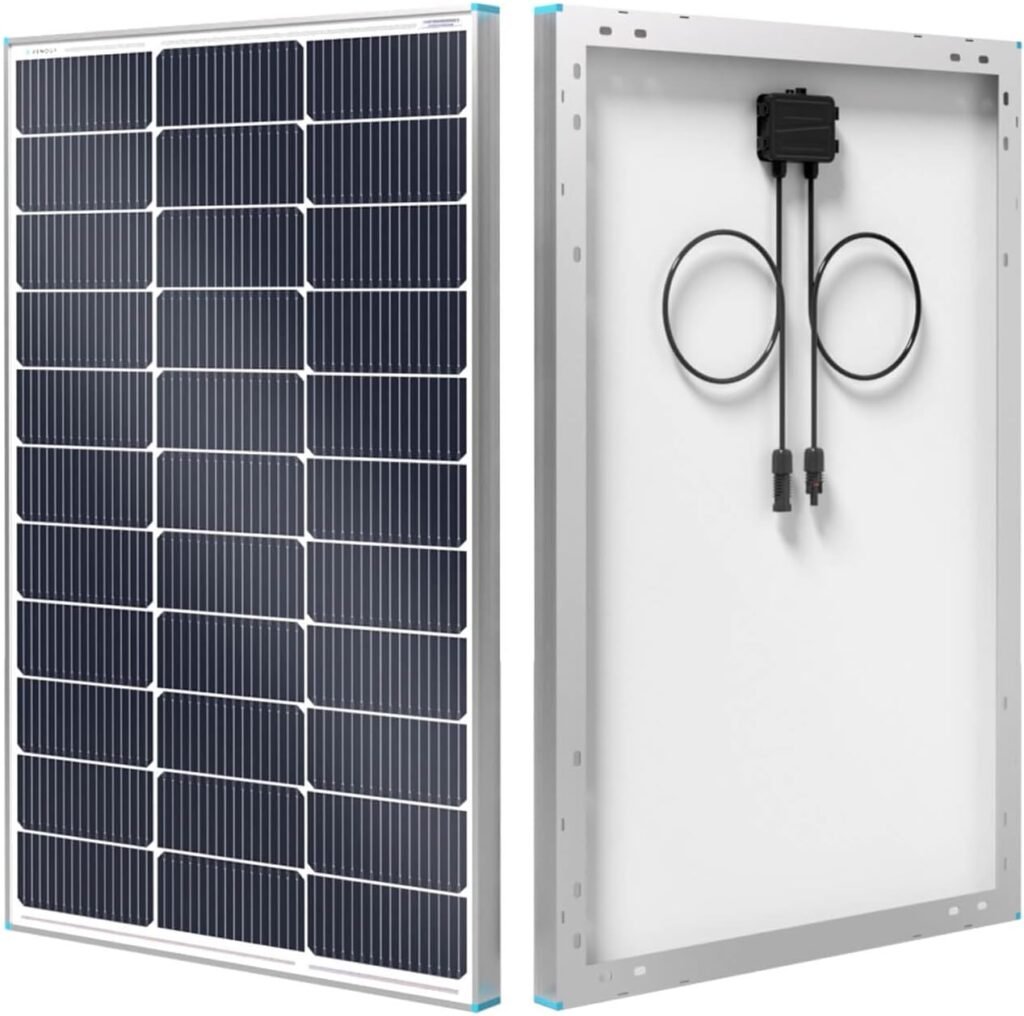
Renogy 100W N-Type Solar Panel Review
★★★★☆
Price
$90–$110
Best For
Homeowners with a permanent sunny spot who want the cheapest, longest-lasting solar watts.

Check Price on Amazon

Watch a Video Review

Key Takeaways

  • Best for: a permanent shed, rack or ground mount feeding a power station
  • Standout: 10-year warranty and a 25-year output guarantee for about $100
  • Watch out: no stand, and each panel adds only 100W
  • Not for: grab-and-go setups or anyone short on mounting space

The Renogy 16BB N-Type 100W is a rigid glass-and-aluminum solar panel you mount on a shed, rack or ground stand to feed a power station or battery. It usually sells for $90 to $110.

What it can power

In 4 to 5 hours of good sun, one panel gives roughly 300 to 375Wh a day (estimate: 100W x 4-5 sun hours x 0.75). That covers a Wi-Fi router and lights, but a full-size fridge needs three or four panels. Four panels land near 1,200 to 1,500Wh a day. Because a rigid panel stays put, tilt the mount toward the south once and it keeps working without daily setup. Winter output will still run lower.

Compatibility and mounting

  • Power stations: MC4 leads, so use an MC4-to-XT60, Anderson or DC8020 cable to match your station.
  • Series wiring: two in series reach about 45.6V open-circuit, safe on 60V inputs.
  • Mounting: no stand included. Use Z-brackets, a tilt mount or a DIY frame.
  • Roof mounts on a house: hire a licensed electrician or installer, and check local permit rules.

How it compares

Renogy 100W N-Type ALLPOWERS SE200 Jackery SolarSaga 200W
Typical price $90–$110 $139–$189 $379–$429
Rated output 100W 200W 200W (225W bifacial)
Weight 13.0 lb 15.8 lb 14.3 lb
Open-circuit voltage 22.79V 48.96V 22V
Plug / water rating MC4, IP65 box, IP67 plugs MC4, IP68 DC8020, IP68
Best for Permanent mounts on a budget Lowest cost per watt in a folder Jackery owners

See my ALLPOWERS SE200 and Jackery SolarSaga 200W reviews.

Want to see other Solar Panels? Compare them side by side →

How I researched this: Renogy’s product page and data sheet, US retailer listings, and owner reports. Daily output figures are estimates. Prices checked September 29, 2026.

Renogy 16BB N-Type 100W Rigid Solar Panel (RSP100DC)
Renogy 16BB N-Type 100W rigid panel review: daily output estimates, wiring and mounting for power stations, price, and how it stacks up against ALLPOWERS.

Product Brand: Renogy

Product Currency: USD

Product Price: 90

Product In-Stock: InStock

Editor's Rating:
4.4

Pros

  • About $1 per watt, among the cheapest watts in this group
  • 10-year product warranty plus a 25-year, 80% output guarantee
  • Glass and aluminum build rated for 5,400Pa snow and 2,400Pa wind loads
  • 22.79V open-circuit lets two run in series on any 60V input

Cons

  • No kickstand; needs a mount, rack or DIY stand
  • Only 100W per panel, so real charging takes several
  • Rigid 34 x 23 in panel does not fold for storage
  • About 20% module efficiency, so it needs more space per watt than folders

Specs

ModelRSP100DC
Rated power100W
Open-circuit voltage (Voc)22.79V
Max-power voltage (Vmp)19.97V
Max-power current (Imp)5.01A
Short-circuit current (Isc)5.31A
CellsN-type, 16 busbar; 20% module efficiency
Weight13.0 lb
Size34.1 x 22.8 x 1.2 in (rigid, aluminum frame)
RatingIP65 junction box, IP67 MC4 connectors

Verdict

The best buy here if your panels can stay mounted outside: cheap per watt and backed for 10 years. If you need to pack solar away or set it up in minutes, get a folding panel like the ALLPOWERS SE200.

Share this review Facebook Pinterest
Was this helpful?
One tap. Helps us make the site better.
Only used to answer you. Never shown, shared or added to any mailing list.
🔒 No name needed. Email only if you want a reply.
Thanks! We read every message.

Common Questions

Can it charge a 12V battery directly?
Not safely. Put a solar charge controller between the panel and a bare battery. A power station already has one built in.
What happens if one panel is shaded?
In series, shade on one panel drags down the whole string. If part of your spot gets shade, wire the panels in parallel.
Should I tilt it or lay it flat?
Tilt it toward the south at roughly your latitude for the most output year-round. Flat panels also collect more dirt and snow.